Financial analyst resume example

One target role.
The complete preparation behind it.

Follow Alex Morgan’s sample application for ASML’s Manufacturing Controller role. Read the original experience, see the specific edits, and inspect the full preparation pack.

An illustrative candidate profile with exported sample files. This example shows the materials; it does not report an interview, offer or customer outcome. ASML is the target company in the example, with no affiliation implied.

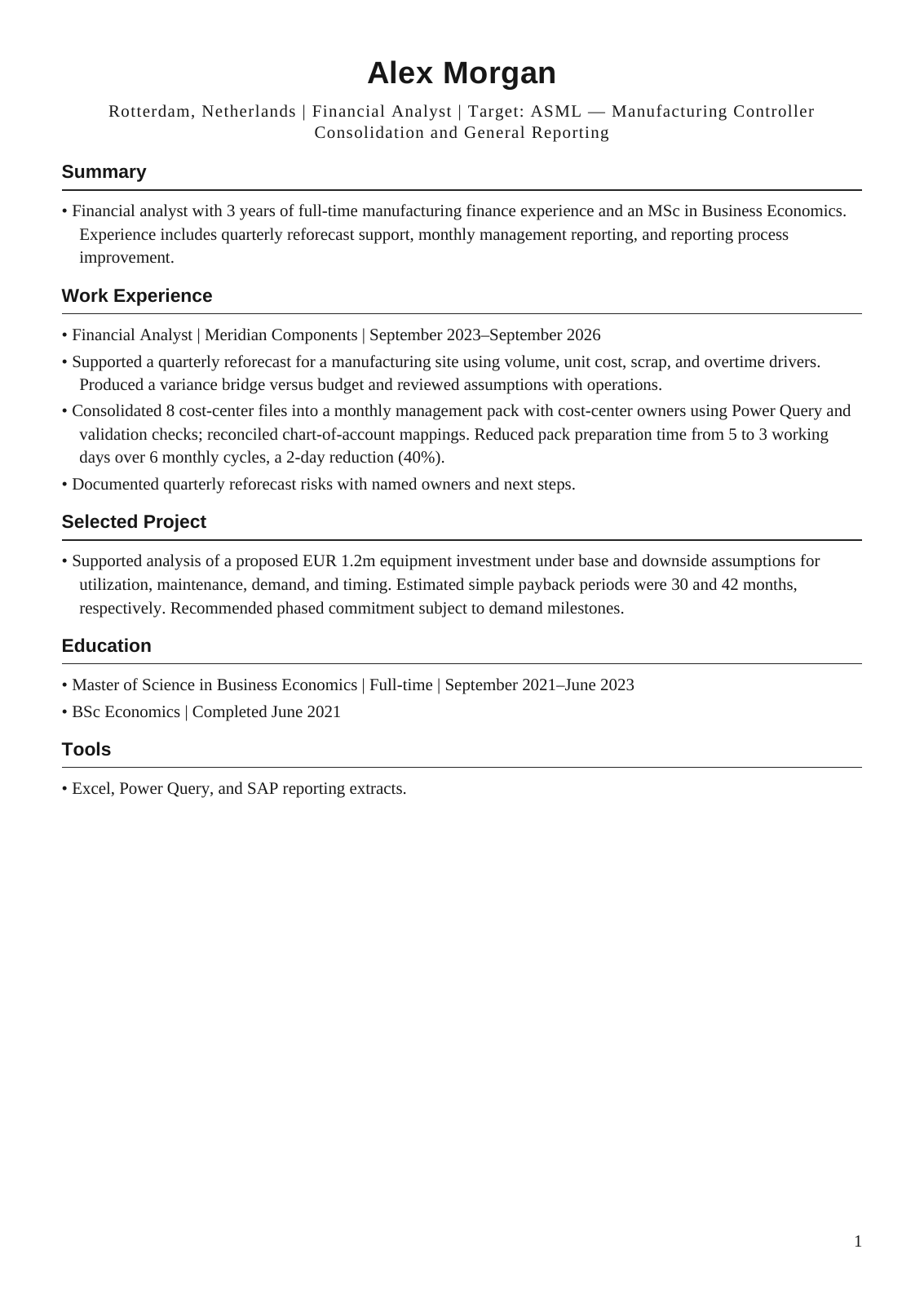
First page of Alex Morgan’s tailored resume

Open the complete PDF or Word files below.

Starting pointWhat changedComplete materialsSource links

A move toward forecasting ownership

Alex’s sample profile has three years in manufacturing finance, an MSc in Business Economics, and experience with Excel, Power Query and SAP reporting extracts.

What the role asks for

Monthly forecasting, consolidated management information, stakeholder coordination and follow-through on financial risks. Planning applications are part of the role’s requirements. [S01]

What the profile supports

Quarterly reforecast support, consolidation of eight cost-center files, and analysis of a proposed equipment investment. The resume can make these contributions easier to assess.

What remains a learning gap

The supplied profile establishes support experience rather than ownership of monthly forecasting. SAP BW, SAC and Spotfire remain development topics.

Read the original resume

Alex Morgan

Rotterdam, Netherlands | Financial Analyst

Summary

Financial analyst with 3 years of full-time finance experience in manufacturing, covering management reporting, reforecast support, and equipment investment analysis.

Work Experience

Financial Analyst | Meridian Components | September 2023–September 2026

• Consolidated a monthly management pack from 8 cost-center files. Reconciled chart-of-account mappings. Used Power Query and validation checks, working with cost-center owners.

• Reduced pack preparation time from 5 to 3 working days over 6 monthly cycles, a reduction of 2 working days (40%). The measure covered pack preparation, not the financial close.

• Supported a quarterly reforecast for a manufacturing site using volume, unit cost, scrap, and overtime drivers. Produced a variance bridge versus budget and reviewed assumptions with operations. Documented risks with named owners and next steps. Forecast accuracy improvements, savings, and margin gains were not measured.

• Supported analysis of a proposed EUR 1.2m equipment investment, comparing base and downside assumptions for utilization, maintenance, demand, and timing. Simple payback was 30 months in the base case and 42 months in the downside case. Recommended phased commitment subject to demand milestones. The work was analysis and recommendation only; it did not establish investment approval or realized returns.

Education

Master of Science in Business Economics | Full-time | September 2021–June 2023

BSc Economics | Completed June 2021

Tools

Excel, Power Query, and SAP reporting extracts.

Compare the general resume rewrite

Alex Morgan

Rotterdam, Netherlands | Financial Analyst | Manufacturing Finance

Summary

Financial analyst with 3 years of full-time finance experience in manufacturing. Experience includes monthly management reporting, quarterly reforecast support, and proposed equipment investment analysis, supported by Excel, Power Query, and SAP reporting extracts.

Work Experience

Financial Analyst | Meridian Components | September 2023–September 2026

• Consolidated a monthly management pack from 8 cost-center files. Reconciled chart-of-account mappings and worked with cost-center owners using Power Query and validation checks.

• Reduced management pack preparation time from 5 to 3 working days over 6 monthly cycles, a reduction of 2 working days (40%) in pack preparation.

Selected Projects

• Supported a manufacturing site's quarterly reforecast using volume, unit cost, scrap, and overtime drivers. Produced a variance bridge against budget, reviewed assumptions with operations, and documented risks with named owners and next steps.

• Supported analysis of a proposed EUR 1.2m equipment investment by comparing utilization, maintenance, demand, and timing assumptions across base and downside scenarios. Estimated simple payback was 30 months in the base case and 42 months in the downside case. Recommended phased commitment subject to demand milestones.

Education

Master of Science in Business Economics | Full-time | September 2021–June 2023

BSc Economics | Completed June 2021

Tools

Excel, Power Query, and SAP reporting extracts.

Keep the facts.
Make their relevance clear.

Each edit starts with experience already in the sample profile. The measurement boundary stays attached to the result. Explore six financial analyst resume bullet examples.

Management-report consolidation

Original expression

• Consolidated a monthly management pack from 8 cost-center files. Reconciled chart-of-account mappings. Used Power Query and validation checks, working with cost-center owners.

Rewritten expression

• Consolidated 8 cost-center files into a monthly management pack, reconciling chart-of-account mappings and using Power Query and validation checks with cost-center owners. Reduced pack preparation time from 5 to 3 working days over 6 monthly cycles, a reduction of 2 working days (40%).

Why this edit Connects consolidation methods and stakeholder collaboration to a measured improvement in report preparation.

Manufacturing reforecast

Original expression

• Supported a quarterly reforecast for a manufacturing site using volume, unit cost, scrap, and overtime drivers. Produced a variance bridge versus budget and reviewed assumptions with operations. Documented risks with named owners and next steps. Forecast accuracy improvements, savings, and margin gains were not measured.

Rewritten expression

• Supported a manufacturing site's quarterly reforecast using volume, unit cost, scrap, and overtime drivers. Produced a variance bridge against budget and reviewed assumptions with operations, documenting forecast risks with named owners and next steps.

Why this edit Highlights assumption review, budget variance analysis, and explicit responsibility for risk follow-up.

Equipment investment

Original expression

• Supported analysis of a proposed EUR 1.2m equipment investment, comparing base and downside assumptions for utilization, maintenance, demand, and timing. Simple payback was 30 months in the base case and 42 months in the downside case. Recommended phased commitment subject to demand milestones. The work was analysis and recommendation only; it did not establish investment approval or realized returns.

Rewritten expression

• Supported analysis of a proposed EUR 1.2m equipment investment, comparing utilization, maintenance, demand, and timing assumptions across base and downside scenarios. Estimated simple payback was 30 months in the base case and 42 months in the downside case. Recommended phased commitment subject to demand milestones.

Why this edit Links scenario analysis and estimated payback to a concrete recommendation for phased commitment.

The 40% figure belongs to this sample candidate’s report-preparation work. It is not a Nailrole performance claim or a reduction in the financial-close period. Investment payback figures are estimates from the sample analysis.

Read the complete role pack

The same experience runs through the resume, research and interview preparation. Every file below is available to inspect before creating an account.

Tailored resume Full text, PDF and editable Word

Alex Morgan

Rotterdam, Netherlands | Financial Analyst | Target: ASML — Manufacturing Controller Consolidation and General Reporting

Summary

Financial analyst with 3 years of full-time manufacturing finance experience and an MSc in Business Economics. Experience includes quarterly reforecast support, monthly management reporting, and reporting process improvement.

Work Experience

Financial Analyst | Meridian Components | September 2023–September 2026

• Supported a quarterly reforecast for a manufacturing site using volume, unit cost, scrap, and overtime drivers. Produced a variance bridge versus budget and reviewed assumptions with operations.

• Consolidated 8 cost-center files into a monthly management pack with cost-center owners using Power Query and validation checks; reconciled chart-of-account mappings. Reduced pack preparation time from 5 to 3 working days over 6 monthly cycles, a 2-day reduction (40%).

• Documented quarterly reforecast risks with named owners and next steps.

Selected Project

Supported analysis of a proposed EUR 1.2m equipment investment under base and downside assumptions for utilization, maintenance, demand, and timing. Estimated simple payback periods were 30 and 42 months, respectively. Recommended phased commitment subject to demand milestones.

Education

Master of Science in Business Economics | Full-time | September 2021–June 2023

BSc Economics | Completed June 2021

Tools

Excel, Power Query, and SAP reporting extracts.

Company and role research Responsibilities, fit, learning gaps and questions

ASML: Manufacturing Controller Consolidation and General Reporting

Alex Morgan | Preparation brief | October 25, 2026 | Job J-00354559

Decision overview

This role merits consideration if Alex wants to move from supporting manufacturing finance processes toward owning forecast consolidation and coordinating stakeholders worldwide. The main decision is whether the team’s expectations for independent process ownership and planning-system experience are achievable with their current background and the development support available. [S01]

Business context and financial-control implications

ASML supplies chipmakers with hardware, software, and services for mass production of microchips. Its lithography machines use light to print circuit patterns, and Veldhoven is its global headquarters and largest R&D and manufacturing site. For manufacturing finance, this context makes reliable planning information consequential: consistent assumptions and clear risk reporting can help decision-makers assess operational tradeoffs across a complex technical business. [S02]

Responsibilities and reporting relationship

The role centers on managing and driving monthly forecasting, consolidating and reporting the forecast, and providing reliable management information. It also serves as the key contact for tooling and process questions from stakeholders worldwide. Financial risks and opportunities must be identified, communicated, monitored, and translated into executable actions, making follow-through an explicit part of the responsibility. [S01]

The position reports to the BI&C Global Manufacturing lead. It requires initiating and executing improvements with subject matter experts across planning information, tools, processes, analysis, and organization, while collaborating with and challenging other teams on quality. Influencing without hierarchical authority is an explicit expectation. [S01]

Candidate fit and development priorities

Alex has a relevant foundation: three years of full-time manufacturing finance experience and a master’s degree in Business Economics. The candidate’s reporting and reforecast work supports a credible fit discussion, but this position requires ownership of monthly forecasting and extensive experience with complex processes and planning applications. SAP BW, SAC, and Spotfire should remain development topics; their established tools are Excel, Power Query, and SAP reporting extracts. [S01]

Prepare evidence around three contributions. Consolidating eight cost-center files and reconciling account mappings demonstrates reporting discipline; pack preparation fell from five to three working days over six monthly cycles, a 40% reduction in preparation time, not close duration. The quarterly reforecast used volume, unit cost, scrap, and overtime drivers, without measured forecast-accuracy improvements, savings, or margin gains. Analysis of a proposed EUR 1.2 million equipment investment compared estimated simple paybacks of 30 and 42 months under base and downside assumptions. The phased-commitment recommendation did not establish approval or realized returns.

The listing gives 2–3 years in its summary and 1–3 years in its detailed requirements; Alex’s three years fits both. Their supplied history does not establish the preferred high-tech experience within an international public group or extensive planning-application experience. [S01]

What to investigate before deciding

Clarify team responsibilities, forecast scope, decision rights, deadline pressures, and the balance between recurring reporting and improvement work. ASML describes collaboration, care, training, and coaching as features of its employment offering; investigate how this team puts them into practice. The job is full time, hybrid, based in Veldhoven, and lists no travel. Exact office days and compensation are unspecified; assess the commute from Rotterdam against the actual arrangement. [S01][S03]

Three questions to ask

Which forecast stages would I own, how are responsibilities divided across the team and worldwide contributors, and what would strong performance look like after six months?

Which SAP BW, SAC, or Spotfire capabilities are needed immediately, and what training, coaching, and protected learning time would support development in this team?

What are the role’s compensation range and benefit components, and how are office attendance, remote work, and availability during forecasting deadlines arranged?

Short preparation plan

Build three concise evidence stories covering reporting controls, forecast assumptions, and investment tradeoffs, clearly distinguishing personal contributions from team decisions. Practice explaining a forecast variance and tracing a data inconsistency through account mappings. Outline how to coordinate submissions, resolve exceptions, and track actions in a monthly cycle. Prepare an honest learning agenda for planning applications and ASML’s manufacturing context. [S01][S02]

Interview preparation Introduction, 10 answers and follow-up questions

Introduction

I'm Alex Morgan, based in Rotterdam. I have three years of full-time manufacturing finance experience at Meridian Components and a master's degree in Business Economics. My work has covered management reporting, quarterly reforecast support, and equipment investment analysis.

One contribution relevant to this position was consolidating eight cost-center files into a monthly management pack. I reconciled account mappings and used Power Query and validation checks, working with cost-center owners. Over six monthly cycles, pack preparation fell from five to three working days. I also supported a manufacturing site's reforecast by analyzing operational drivers, preparing a variance bridge against budget, and reviewing assumptions with operations.

I'm interested in ASML's Manufacturing Controller Consolidation and General Reporting role because it combines reliable reporting, forward-looking analysis, and process improvement. I would bring practical consolidation experience while developing toward broader monthly forecasting ownership. My established tools are Excel, Power Query, and SAP reporting extracts; I would need to learn SAP BW, SAC, and Spotfire, alongside ASML's semiconductor equipment manufacturing context.

Q01. How did you reduce monthly management-pack preparation from five to three working days?

I consolidated eight cost-center files into a monthly management pack at Meridian Components. My contribution included reconciling chart-of-account mappings and using Power Query and validation checks, working with cost-center owners. That combined data consolidation with checks on how the inputs were classified. Over six monthly cycles, pack preparation fell from five to three working days, a reduction of two working days, or 40%. That measurement covered pack preparation, not the financial close. For me, the useful lesson is that reporting improvement needs both efficient data handling and attention to input quality. In this role, I would apply that discipline after understanding the forecast structure, reporting requirements, and responsibilities of the contributing teams.

Q02. What does your consolidation experience tell you about checking whether management information is reliable?

My experience includes reconciling chart-of-account mappings when consolidating eight cost-center files, using Power Query and validation checks with cost-center owners. That makes me cautious about treating a completed refresh as proof that a report is correct. For a new reporting process, I would check that all expected files were included, reconcile source totals to the consolidated output, and investigate unmapped or duplicated items. I would also check whether classifications were consistent across contributors. If an exception remained, I would explain its potential effect and identify who needed to resolve it. The specific checks would depend on the reporting structure; I would first understand that structure rather than assume my previous setup applied.

Q03. How did you connect operational drivers to a manufacturing reforecast?

I supported a manufacturing site's quarterly reforecast using volume, unit cost, scrap, and overtime drivers. I produced a variance bridge against budget and reviewed assumptions with operations. My contribution was supporting the analysis; I did not own the entire forecasting process. When explaining those drivers, I would distinguish changes in activity from changes in cost or operating performance. For example, higher volume and a higher unit cost need different explanations, even if both increase total cost. I would also examine whether scrap and overtime assumptions were consistent with the production outlook. Forecast accuracy improvements, savings, and margin gains were not measured, so I would describe the work through its analysis and documented assumptions.

Q04. How would you draw on your experience reviewing operational assumptions to challenge a forecast constructively?

In the quarterly reforecast I supported, I reviewed assumptions with operations and produced a variance bridge against budget. That is the experience I would draw on when challenging a forecast. I would start with the assumption and its financial consequence, then ask what operational evidence supports it. If volume increased while overtime stayed unchanged, for instance, I would ask how the capacity requirement would be covered. I would distinguish a different judgment from a data inconsistency and keep unresolved assumptions visible. My role would be to make the tradeoff understandable and seek an accountable next step. I would not imply that reviewing assumptions gave me authority to set another team's operating plan.

Q05. Walk me through the investment tradeoff behind your phased-commitment recommendation.

I supported analysis of a proposed EUR 1.2 million equipment investment. I compared base and downside assumptions for utilization, maintenance, demand, and timing. Estimated simple payback was 30 months in the base case and 42 months in the downside case. Those were alternative scenarios, not an improvement achieved over time. I recommended phased commitment subject to demand milestones. My reasoning was to balance committing capital against uncertainty in the demand assumptions. In discussing that recommendation, I would also ask whether the equipment purchase could practically be phased and what delay might cost. My contribution was analysis and recommendation; I cannot point to an approved investment or realized return from this work.

Q06. What experience do you have turning forecast risks into something people can act on?

During the quarterly reforecast I supported, I documented risks with named owners and next steps. That was my contribution alongside driver analysis and the variance bridge. I would distinguish that documentation from evidence that every action was completed or that financial performance improved. For this position, I would build on that foundation by clarifying what assumption each risk affects, what would signal a change, and when the next review should occur. I would separate an agreed action from a proposed response so management could see what still needed a decision. My focus would be making uncertainty actionable while preserving a clear distinction between the forecast assumption, the risk, and the response.

Q07. How would you prioritize an unresolved reconciliation, a late forecast submission, and a request for additional analysis near the deadline?

I would first assess which issue could change the consolidated forecast or prevent a responsible submission. An unresolved reconciliation could take priority if it affected a material figure, while a missing submission might matter more if it left a major part of the forecast uncovered. I would establish the impact and dependencies before choosing the sequence. I would contact the relevant owners, agree on the minimum information needed, and explain any remaining uncertainty to the person responsible for submission. For additional analysis, I would clarify the decision it supported and whether it could follow the deadline. I would make the tradeoffs explicit and seek a decision where timing or risk exceeded my authority.

Q08. How would you approach the transition from your manufacturing finance background to ASML's semiconductor equipment business?

I would start by understanding how ASML's lithography equipment manufacturing translates into the forecast this team consolidates. ASML supplies equipment, software, and services to chipmakers, so I would not assume its economics match those of a chip manufacturer or my previous employer. I would ask which manufacturing activities, cost categories, and planning horizons fall within this role. Then I would trace a representative forecast from operational assumptions through reporting, with subject matter experts explaining unfamiliar dependencies. My three years in manufacturing finance would give me a foundation for asking questions about volume, cost, scrap, and overtime. I would validate which drivers actually matter here before reusing an earlier analytical approach.

Q09. How would you learn SAP BW, SAC, and Spotfire while maintaining reporting quality?

My established tools are Excel, Power Query, and SAP reporting extracts. I would need to learn SAP BW, SAC, and Spotfire. I would first clarify which applications and tasks this team expects me to handle immediately, because the learning priorities should follow the actual workflow. For a representative report, I would trace the data source, account mappings, filters, and aggregation logic, then compare the result with an accepted reference. I would use available training and ask an experienced colleague to review my understanding before making consequential changes. My initial goal would be to explain and reproduce the required output reliably, then investigate improvements once I understood the controls and dependencies.

Q10. How would you step up from quarterly reforecast support to coordinating a monthly forecast with worldwide contributors?

I would treat monthly forecast ownership as a step beyond my quarterly reforecast support. First, I would confirm the scope, decision rights, calendar, and responsibilities across contributors. I would seek agreement on submission requirements, common assumptions, and how exceptions should be raised. During the cycle, I would track completeness and unresolved issues, then reconcile the consolidated view and explain significant movements. With worldwide contributors, I would make deadlines and handoffs clear across time zones. After submission, I would review recurring bottlenecks with subject matter experts and prioritize a manageable improvement. I would also clarify which decisions I could make independently and when I should involve the BI&C Global Manufacturing lead.

Questions to ask the team

I understand this role drives monthly forecasting with worldwide contributors. Which stages would I own, how are decision rights divided, and what would strong performance look like after six months?

I see SAP BW, SAC, and Spotfire referenced in the posting, and ASML describes training and coaching opportunities. Which capabilities would I need immediately, and what training, coaching, and dedicated learning time are available in this team?

I would like to understand how the hybrid arrangement works for this Veldhoven role. What office attendance and availability would be expected during forecast deadlines, and how does the team balance recurring delivery with process improvement?

Check the sources behind the research

This example uses the official role listing and ASML’s own company and careers pages. The sample was prepared on October 25, 2026; job availability and role details can change.

Company pages describe the employer’s own position. Team practices, compensation and exact office arrangements still need to be confirmed with the hiring team.

Start with your own experience.

Try one free general resume rewrite per account. A paid role pack adds a tailored resume, company research and interview preparation for one target role.

Try your resume freeSee role-pack pricing